Farm Skills
Drive through almost any old rural village in Europe or North America and you will eventually pass a building with a wide door and a dark interior, often now a gift shop or a tea room, sometimes with a sign that says 'The Old Smithy.' The sign is usually the only clue that this was once one of the most important buildings in the community. For centuries, the blacksmith was the person who kept the tools of farming working. Without him, the plow would not cut, the wagon wheel would not roll, and the horse would not go.
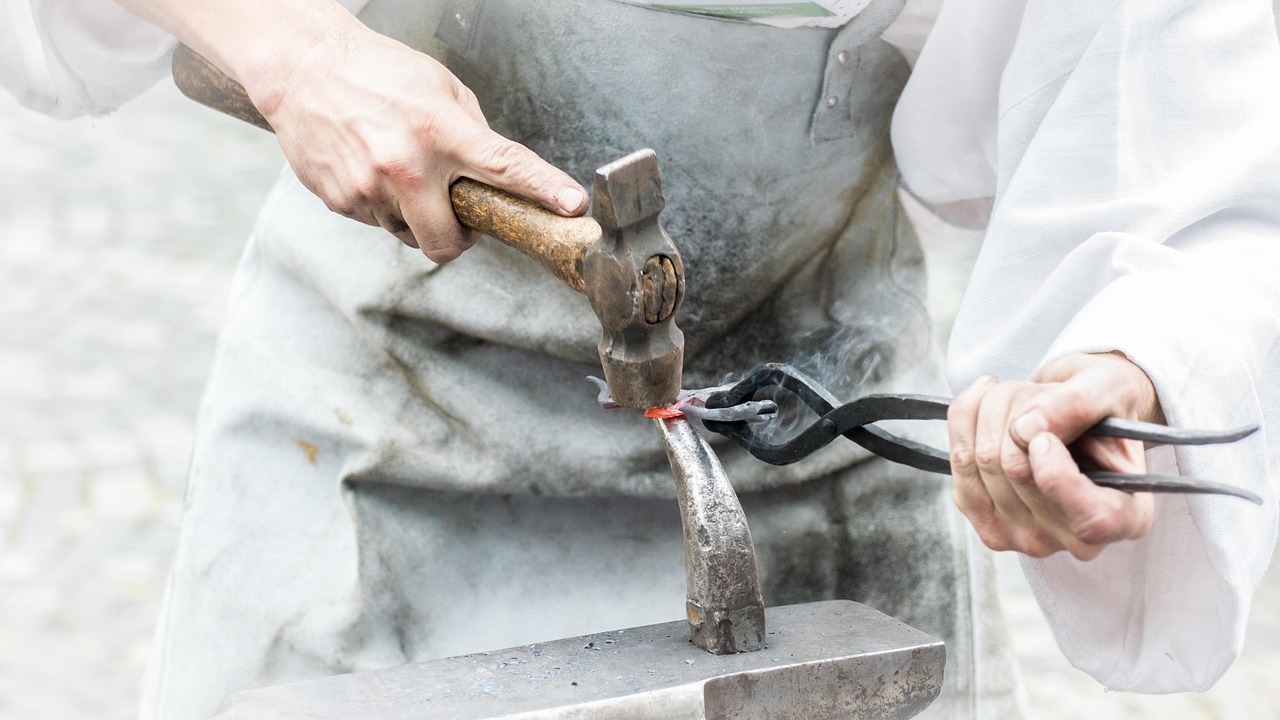
The smith's craft was fire and iron. He worked at a forge, a small hearth fed with coal and kept hot by a bellows, often turned by a boy or an apprentice. The iron was heated until it glowed yellow-white, then shaped on an anvil with hammer and tongs. The work required strength, precision, and an eye for how metal moved under the hammer. A good smith could make a horseshoe in a few minutes; a great one could make a plowshare that would last a decade.
Farming in the pre-industrial era depended almost entirely on iron tools made or repaired by the local smith. Plows, harrows, hoes, scythes, sickles, axes, chains, hinges, nails, horseshoes—all of it came from the forge. A smith might also make household items: fire dogs, cooking trivets, door latches, even nails. In some villages, the smith was also the farrier, shoeing horses and treating their hooves.
The relationship between smith and farmer was personal. The smith knew which fields a farmer worked and what kind of soil he had. He knew when a plow was likely to wear out and would have a replacement ready. He knew which horses were gentle and which needed a firm hand. When a farmer had a broken tool at harvest time, the smith would work late into the night to fix it. There was no alternative; the nearest town might be a day's ride away, and the crop could not wait.
Apprenticeship was the usual route into the trade. A boy—almost always a boy—would be bound to a master for five or seven years, starting with the bellows and the simplest jobs, gradually working up to the more difficult forging. By the end of his term, he would be expected to produce a 'masterpiece' to prove his skill. Many smiths stayed in the same village for their entire working lives, and their sons often followed them into the trade.
The village smithy began to decline in the late nineteenth and early twentieth centuries, as factory-made tools and machinery became cheap and widely available. Why repair a plow when you could buy a new one for less than the cost of the repair? Why shoe a horse when the tractor was replacing it? The First World War took many young smiths into the army and they did not return to the forge. By the 1930s, many villages had no working smith at all.
What survived was a specialized remnant: farriers who still shoe horses for recreation and racing, and artist-blacksmiths who make decorative ironwork. Both are honorable trades, but they are not the same as the village smithy. The old craft was not about decoration. It was about keeping the machinery of food production running, one repaired tool at a time.
There is something in the image of the smithy that still speaks to us—the glow of the fire, the ring of the hammer, the smell of hot iron and coal. It is the image of work that was skilled, necessary, and rooted in a particular place. When we lose that kind of work, we lose more than a trade. We lose a way of understanding what it means to be useful.
